
There's no doubt that hurricanes are complicated beasts with complex origins.
But following the Atlantic's extremely active 2017 hurricane season, a group of scientists at Princeton University's Geophysical Fluid Dynamics Laboratory have identified a connection between the six major hurricanes -- with winds over 110 mph -- that churned in the ocean, three of which pummeled the U.S.
All were supercharged by unusually warm waters, and these warm conditions outweighed other weather factors.
This research -- published on Thursday in the journal Science-- has significant climate change implications, as the world is expected to continue its accelerating warming trend.

 Hurricane Irma on Sept. 8, 2017.Credit: nasa
Critically, over 90 percent of the accumulating heat on Earth is absorbed by the planet's oceans.
"Global warming is really ocean warming," NASA oceanographer Josh Willis said.
Hurricanes feed off warm waters. It's their fuel. But still, warm waters alone don't stoke hurricanes.
SEE ALSO:How flocks of birds got trapped inside the eye of Hurricane FlorenceTo pinpoint the factors that drove the 2017 hurricane season, the Princeton scientists used a sophisticated climate computing model to simulate the different wide-scale weather conditions on Earth. This is no easy task. Any hurricane season has a number of influences that may propel, or dampen, the storm season or any particular storm.
"It's quite complicated, there’s many moving parts," Colin Zarzycki, a storm scientist at the National Center for Atmospheric Research who had no role in the study, said in an interview. "It's not just ocean temperature. It's kind of a big tangled web."
 Hurricane Harvey as seen from the International Space Station in August 2017.Credit: nasa
But even so, after simulating different weather conditions, it became clear that other major climate factors -- like cooling in the Pacific waters -- were overpowered by the effects of the unusually warm ocean temperatures in the Atlantic.
The increase in 2017 hurricanes was caused "mainly by pronounced warm sea surface conditions in the tropical North Atlantic," the researchers wrote.
But there was another critical factor driving these storms.
"The key point is that the Atlantic was warmer than other open oceans all over the world," the study's lead author, Hiroyuki Murakami, said in an interview.
This caused more warm air to rise up into the sky over the Atlantic, making the atmosphere more unstable -- and ripe for tumultuous storm activity.
In short, the Atlantic ocean got an "extra kick" from all this rising motion, Hugh Willoughby, a hurricane scientist at Florida International University, said over email.
"As a result, thunderstorms that feed hurricanes become stronger," said Willoughby.
 Hurricanes Maria and Jose in September 2017.Credit: nasa
The Atlantic wasn't just warm -- it was much warmer than Earth's other oceans. But regardless, just having unusually warm waters in the Atlantic is still going to fuel powerful storms.
"When you get an ocean basin that gets warm like that, it really primes the atmosphere to be conducive to these strong storms," said Zarzycki. "When you boil it down, with warmer atmosphere and sea surface temperatures, under ideal conditions we would expect storms to be stronger."
That said, Zarzycki underscores that other weather factors -- like strong wind shear that pummels and weakens hurricanes -- can weaken or tear apart any storm. But without these weakening factors, hurricanes can really ignite -- as they did in 2017.
Going forward, what might this all mean for the future storm activity? Should we expect more major hurricanes?
In future decades, perhaps by 2080, warming oceans may boost the count of major storms in the Atlantic during a busy season from six to eight, said Murakami. This means more opportunities for giant storms to hit the U.S. coast.
But in the next 10 years, he can't say if warmer oceans might generate more major hurricanes. Weather patterns, or natural variability, are just too unpredictable.
 Hurricane Maria passing over Puerto Rico.Credit: nasa
"It remains uncertain as to whether we will see more frequent active hurricane seasons like 2017 in the upcoming decade due to the dominant influence of natural variability," Murakami said.
For example, there's a major climate trend running on 30-year timescales called the Atlantic Multi-Decadal Oscillation, that can warm or cool vast swaths of the Atlantic, said Willoughby.
Saharan dust from Africa also blows over the ocean, which can cool the waters, he said. And there are major influences from the Pacific Ocean that can drive down wind shear in the Atlantic.
"All of these well-established oceanic vacillations make it harder to define the long-term warming caused by us humans," said Willoughby.
So, it's complicated.
But one thing is much more certain: Warm oceans fueled the Atlantic's extremely active 2017 season. And overall, we can expect more warm water.
(责任编辑:熱點)
Researchers create temporary tattoos you can use to control your devices Hooked on 'The Circle'? Give 'The Circle Brazil' a whirl
 Sony unveils its new DualSense controller with improved triggers
 Instagram meme account with 14 million followers banned for coronavirus scamAustralian football makes history with first LGBT Pride Game
More than half of women in advertising have faced sexual harassment, report says
If you are a woman in advertising, chances are you've faced workplace sexual harassment at one point
...[详细]Free Speech Coalition calls for porn productions to shut down amid coronavirus
 The Free Speech Coalition (FSC) is calling for an immediate, voluntary shutdown of adult productions
...[详细]
The Free Speech Coalition (FSC) is calling for an immediate, voluntary shutdown of adult productions
...[详细]Actually, wear whatever you want while working from home
 I don't know who needs to hear this, but here we go: We're living through a pandemic. Wear whatever
...[详细]
I don't know who needs to hear this, but here we go: We're living through a pandemic. Wear whatever
...[详细]Naked man crashing school's video call is a privacy lesson for all
 Everyone is stuck inside right now, and everyone is videoconferencing. Yes, even creeps. The coronav
...[详细]
Everyone is stuck inside right now, and everyone is videoconferencing. Yes, even creeps. The coronav
...[详细]PlayStation Now game streaming is coming to PC
Sony's PlayStation Now service is launching for Windows PC, meaning subscribers will soon be able to
...[详细]Everything coming to HBO Now in April 2020
 Looking for more to stream? Here's what's hitting HBO Now next month.This April, the streaming servi
...[详细]
Looking for more to stream? Here's what's hitting HBO Now next month.This April, the streaming servi
...[详细]'Persona 5 Royal' first impressions: Same same but different
 If you’re interested in Persona 5 Royal, chances are you’ve already played Persona 5. An
...[详细]
If you’re interested in Persona 5 Royal, chances are you’ve already played Persona 5. An
...[详细]The 34 best Instagram accounts to capture your hearts
 Since everyone and their mother (and their dog) is on Instagram, it can be tough to separate the bla
...[详细]
Since everyone and their mother (and their dog) is on Instagram, it can be tough to separate the bla
...[详细]Visualizing July's astounding global temperature records
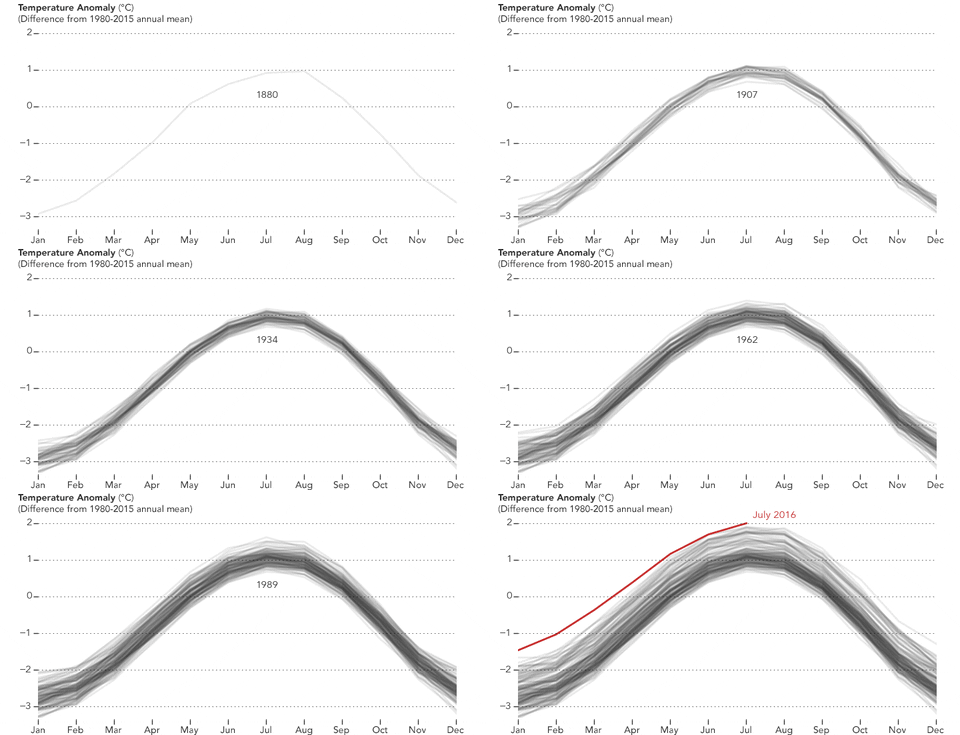 July set a rare temperature record during a year that is featuring off the charts warmth. The month
...[详细]
July set a rare temperature record during a year that is featuring off the charts warmth. The month
...[详细]Please enjoy these dogs singing along to the ‘Law & Order’ theme song
 In these trying times it's essential to take a step back from your anxious thoughts every day and en
...[详细]
In these trying times it's essential to take a step back from your anxious thoughts every day and en
...[详细]Sound the alarms: Simone Biles finally met Zac Efron
'Tiger King' Season 2? Producers say more of Netflix docuseries could be on way